



Sprinklers aren’t enough: how to contain an EV fire in a parking garage or parkade
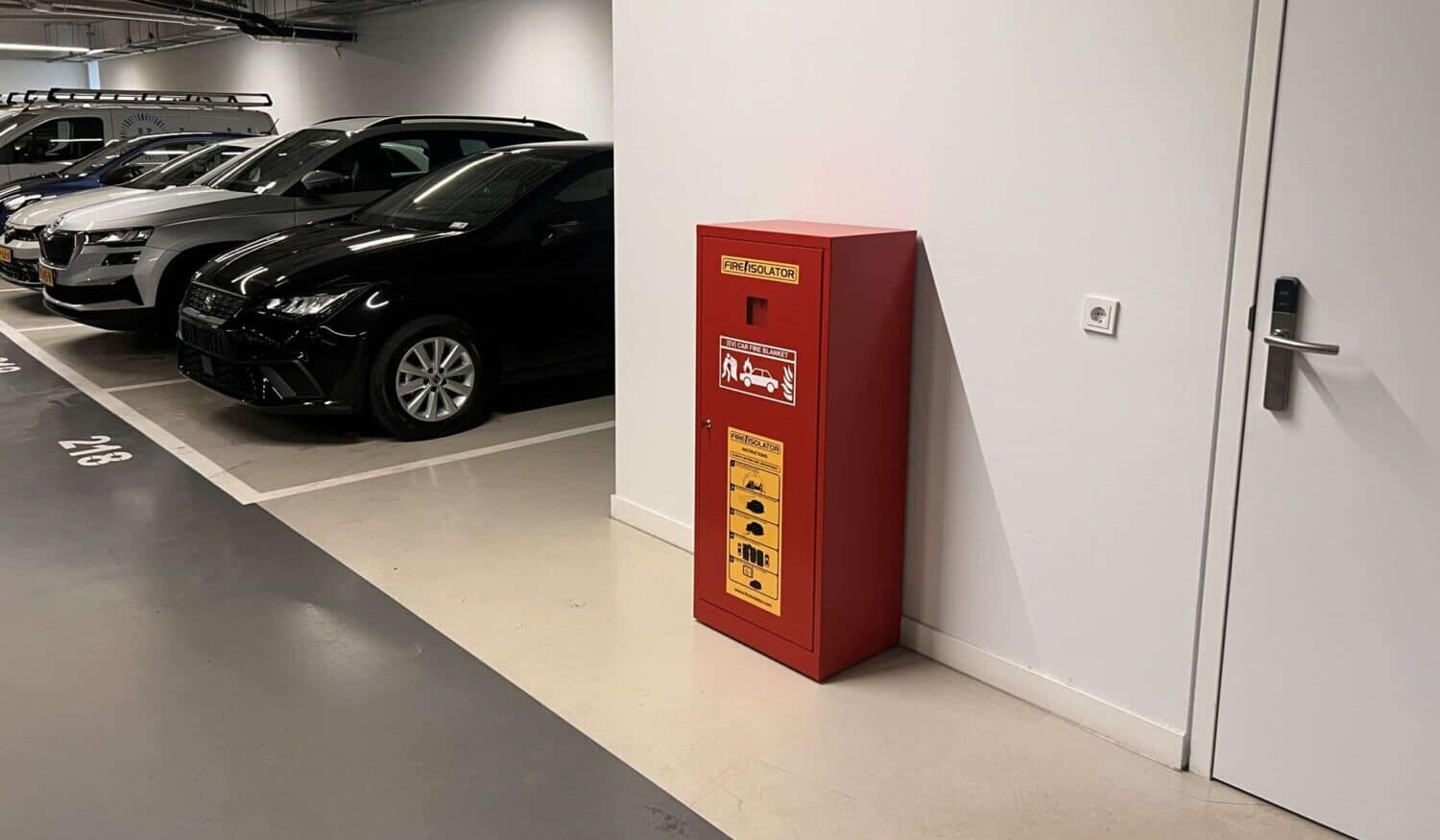
Electric vehicle fires in car parks are increasingly making headlines. From underground parking garages to airport multi-storey parking garages, shopping mall parking garages to residential buildings, the risk of a lithium-ion battery fire, particularly near charging points, has become one of the most pressing fire safety challenges of our time. Safety managers, fire services, and car park operators are rightly asking the same question: are we prepared?
For many, the answer has been reassuring: “We have sprinklers.” And while sprinklers are an important first line of defence, the reality of an EV battery fire demands significantly more. This article explains why and what a comprehensive, proven containment concept looks like.
Why EV fires are different
A conventional petrol or diesel vehicle fire behaves in a way that fire services understand well. Cut off the oxygen, apply water, and the fire can be brought under control. A lithium-ion battery fire is a fundamentally different beast.
When a battery enters thermal runaway, a self-sustaining chain reaction inside the battery pack, it generates its own oxygen as it burns. That means it does not require external oxygen to function. It can burn at temperatures exceeding 1,000°C, release a cocktail of toxic and flammable gases, including hydrogen fluoride, and reignite hours or even days after it appears to have been suppressed.
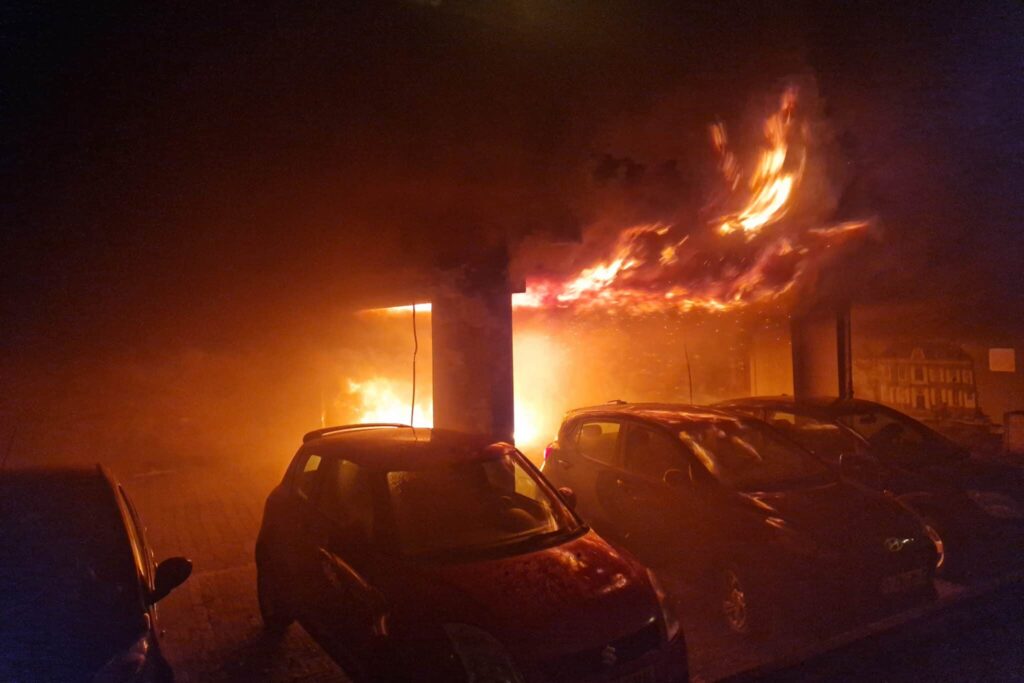
In an enclosed parking garage or parkade, these characteristics create a uniquely dangerous scenario. Toxic gases accumulate. The risk of ignition or deflagration, a rapid, subsonic explosion, becomes real. Adjacent vehicles are at serious risk of catching fire. And the structural integrity of the building itself may be threatened.
What sprinklers do, and what they don’t
Sprinkler systems are valuable. When triggered, they spray water over the roof of a burning vehicle, keeping surrounding surfaces wet and helping to slow the spread of fire to adjacent cars. In a conventional vehicle fire, this can be decisive.
But in an EV battery fire, sprinklers have clear limitations. The water falls on the roof and bonnet of the vehicle, not on the battery pack, which is located in the floor of the car. The thermal runaway continues uninterrupted underneath. The toxic and flammable gases being produced are not contained. The fire is not out; it is simply being wetted from above while it burns from within.
This is not a criticism of sprinkler systems; it is simply a recognition that they were not designed for this problem. Containing an EV battery fire requires a layered, purpose-built approach. That is precisely what the Fire Isolator concept provides.
The Fire Isolator concept: four tools working as one
Developed over more than four years of live fire testing, the Fire Isolator concept is a layered containment system built around four integrated tools. It does not try to stop thermal runaway with a single product. Instead, it combines physical containment, chemical suppression, targeted cooling, and direct intervention to address the fire at every level.
1. The EV fire blanket: contain, not suffocate
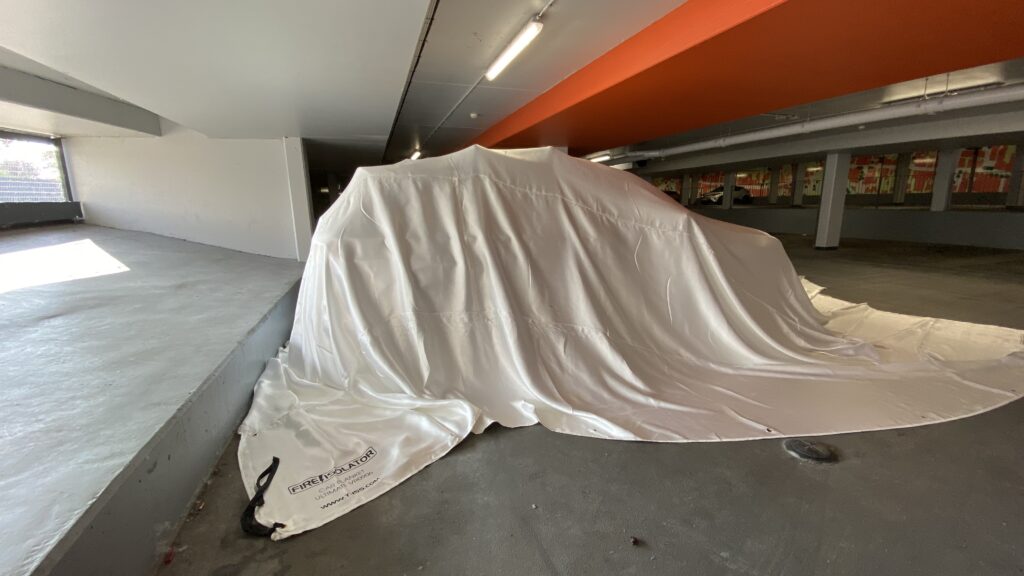
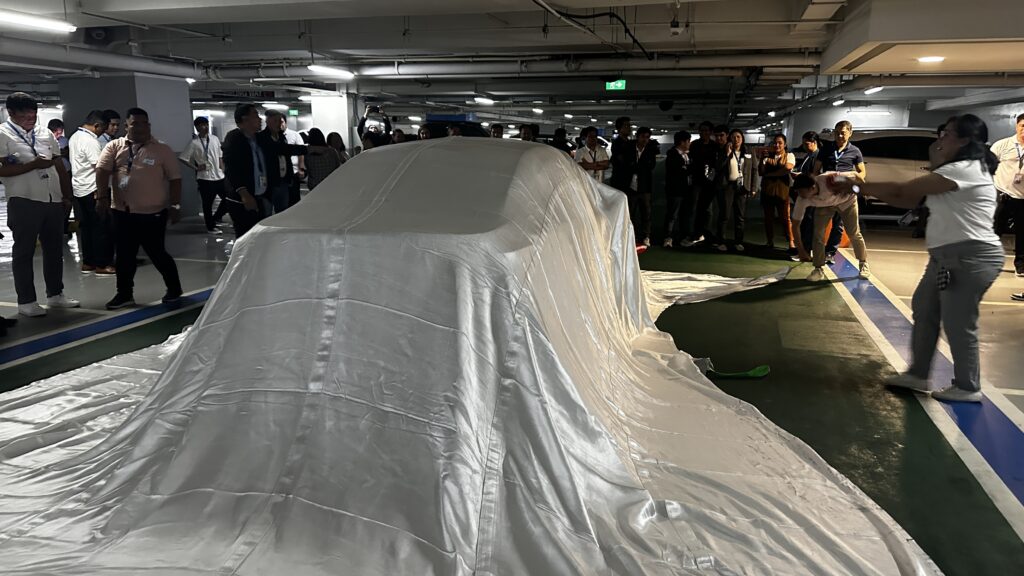
The Fire Isolator EV fire blanket is deployed over the burning vehicle. It is important to understand what it does and what it does not do. Because a battery in thermal runaway generates its own oxygen, the blanket’s role is not to cut off the air supply. Instead, it serves three specific purposes: it physically contains the fire and limits heat radiation to neighbouring vehicles; it minimises the escape of toxic vapours and gases into the surrounding environment; and critically, it creates the confined space that makes the aerosol units effective. And…it wins you time that you need to come up with a plan to extract the car.
2. Potassium nitrate aerosol units: neutralise the gases
Once the blanket is in place, handheld potassium nitrate (KNO₃) aerosol units are deployed underneath it, positioned as close to the battery as safely possible. These units work in six important ways: they cool the combustion zone by absorbing heat; they displace and dilute flammable gases that have accumulated under the blanket; they disrupt the radical chain reactions that sustain combustion; they may interfere with the decomposition chemistry of the battery itself; and together with the blanket, they create conditions in which deflagration, gas ignition or explosion, is actively suppressed.
The results speak for themselves. Across more than 15 live fire tests using the Fire Isolator concept, no gas ignition or explosion has ever been observed. In two of those tests, just two handheld aerosol units were sufficient to stop thermal runaway in NMC lithium-ion batteries entirely. A blanket alone cannot achieve this. The aerosols are what make the difference between containment and genuine suppression.
3. Water mist applicators: cool the battery and protect responders
Water mist is used in two specific ways within the Fire Isolator concept. First, lightweight water mist applicators are slid under the vehicle to deliver cooling water mist directly to the battery compartment, the source of the thermal runaway. Fine water droplets are far more effective at absorbing heat from the air than a focused jet of water, and with a blanket covering the vehicle, a conventional hose would have nowhere effective to aim anyway.
Second, a handheld water mist lance is used to spray mist over the blanket and the surrounding area. This cools the vehicle through the blanket and, just as importantly, knocks down toxic vapours and gases in the air around the vehicle. This is not only fire suppression; it is active protection of the emergency responders working in the space.
4. The EV FireGun: going straight to the source
Perhaps the most innovative element of the Fire Isolator concept is the EV FireGun (FI-FIREGUN), a specialised, fully insulated lance rated to 1,000V (tested to EN/IEC 60900) that physically penetrates the floor pan of the vehicle to reach the battery compartment directly. Development of this tool took over five years of laboratory and live fire testing.
Once inside the battery pack, the FireGun delivers 40 litres of water per minute at two bar directly to the cells in thermal runaway. This internal cooling addresses the fire at its actual source in a way that no external suppression method, however advanced, can replicate. Traditional firefighting approaches require enormous volumes of water applied externally, with limited effectiveness. The FireGun makes the process faster, more targeted, and significantly more efficient. Combined with the other elements of the concept, it dramatically reduces the risk of fire spread and reignition.
Ready to deploy: the Fire Isolator kit
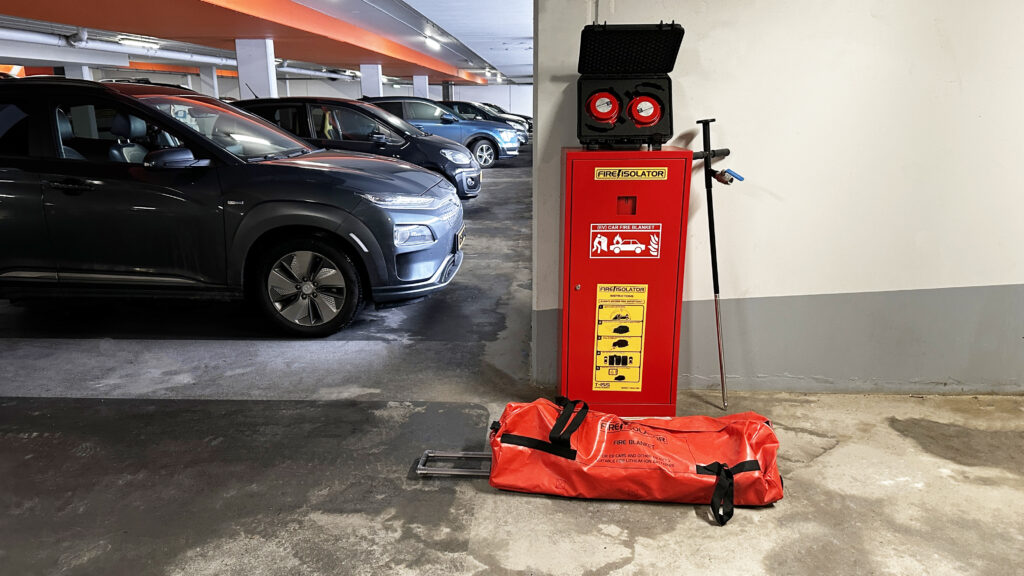
The Fire Isolator concept is not a theoretical framework. It is available today as a complete, deployable kit, housed in a wall-mounted cabinet, containing the fire blanket on a trolley, water mist applicators, and a set of aerosol units. A thermal imaging camera is also included, enabling responders to monitor the situation throughout the incident. Note that the Fire Isolator products need to be deployed by trained personnel, wearing PPE and SCBA in case of flames/fire. We are aware of early detection systems for thermal runaway in car batteries. When a car is just ‘only’ heating up, the responders might wear ‘light’ PPE, but caution is key here, as the off-gassing and jet flames can appear any minute then.
These kits are already deployed in car parks across airports, shopping malls, residential buildings, and commercial premises. Anywhere that EVs charge, and anywhere that the consequences of a battery fire spreading would be catastrophic, a Fire Isolator kit provides the next layer of protection beyond what sprinklers can offer.
What this means for safety managers and parking garage operators
The growth of EV adoption is not slowing down. Neither is the frequency with which EV battery fires make the news. For anyone responsible for the safety of a car park, particularly one with charging infrastructure, the question is no longer whether to take this seriously. It is whether your current provisions are genuinely adequate.
Sprinklers are a necessary starting point. They are not a complete answer. The Fire Isolator concept fills the gap that sprinklers cannot: containing the fire, neutralising the gases, cooling the battery from within, and giving emergency responders the tools and the safe working environment they need to manage the incident effectively.
If you are a safety manager, fire officer, or car park operator reviewing your EV fire preparedness, we would welcome the conversation. The Fire Isolator concept has been tested in real fires, refined over the years, and is ready to be part of your safety plan.
Contact our team today to start the discussion.