



What Is the Best EV Fire Blanket for Vehicle Fleets?
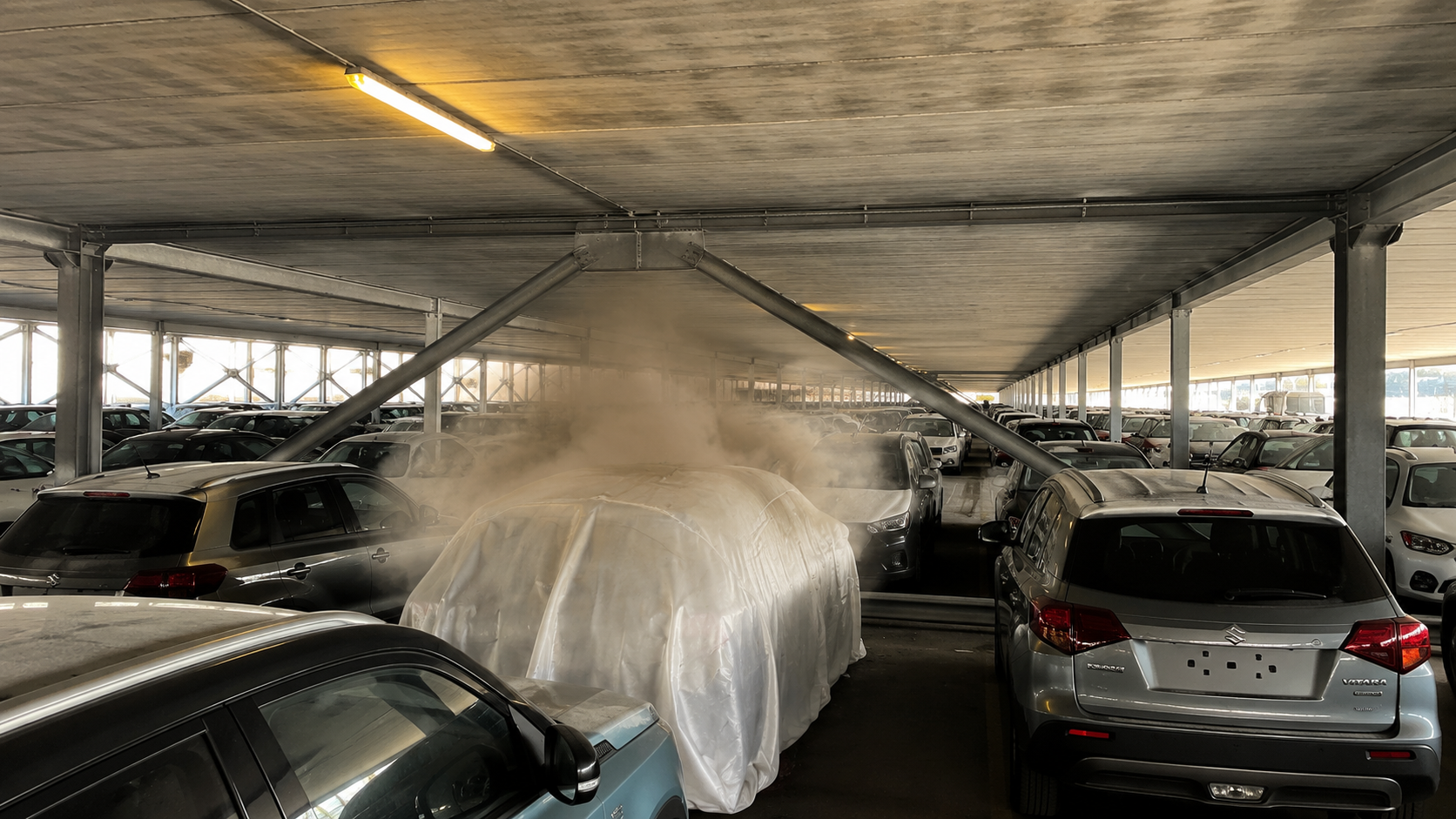
For a vehicle fleet, the best EV fire blanket is not simply the blanket with the highest advertised temperature resistance. Fleet operators should compare EV fire blankets based on real-world testing, gas management, material construction, temperature resistance, size, durability, ease of deployment and how the blanket fits into a complete EV fire-response procedure.
There is also an important limitation every fleet manager should understand: an EV fire blanket should primarily be considered a containment tool, not a guaranteed method of extinguishing a lithium-ion battery in thermal runaway.
That distinction matters.
Why vehicle fleets need a different approach to EV fire risk
Vehicle fleets increasingly contain a mixture of internal-combustion, hybrid and fully electric vehicles. At rental facilities, these vehicles may be parked close together, stored indoors or underground, charged near other vehicles, or positioned close to buildings and infrastructure.
In such environments, the immediate objective during a vehicle fire may not only be extinguishment. Preventing flames, heat and burning debris from spreading to neighbouring vehicles can be equally important.
An EV fire blanket can provide a physical containment barrier around the vehicle and help reduce this collateral exposure while emergency responders manage the incident.
However, not all EV fire blankets work in exactly the same way.
How should a rental fleet compare EV fire blankets?
We recommend comparing at least the following factors.
1. Look for real-world fire testing
A temperature specification on a datasheet tells you something about a material. It does not tell you everything about how a complete blanket will behave when deployed over a burning vehicle.
Ask manufacturers:
Has this actual product been used in live vehicle fire tests?
At FIRE⚡ISOLATOR, our product development is based heavily on practical experience. Together with professional firefighters and international partners, we have conducted more than 15 live tests involving hybrid vehicles, full EVs and lithium-ion batteries in thermal runaway.
Those tests have helped us develop and improve not only our blankets, but our wider EV fire containment concept.
We publish videos of our live tests because fleet managers should be able to see how fire-safety products perform under realistic conditions rather than relying solely on marketing claims.

2. Understand what happens to battery gases
This has become one of the most important questions when comparing EV fire blankets.
During lithium-ion thermal runaway, a battery can continue producing flammable gases even when visible flames have been reduced.
In 2025, US fire-safety organisations warned about the potential for flammable gases to accumulate beneath EV fire blankets during battery thermal runaway. Eliminating external oxygen may suppress visible flaming without stopping thermal runaway inside the battery.
This means fleet managers should ask a very specific question:
Where do the gases go when the blanket is covering the vehicle?
FIRE⚡ISOLATOR’s Economy, Ultimate and Ultra blankets use a breathable material structure. Rather than attempting to create an airtight enclosure around the vehicle, the material allows gases and vapours to escape while the blanket continues to contain flames, heat and burning debris.
This distinction is intentional.
Our Ultra blanket, which is designed for the most demanding applications and maximum durability, uses a different construction. This Ultra blanket is made of 96% silica, impregnated with graphite.
This is also why FIRE⚡ISOLATOR does not believe an EV fire blanket should be viewed as a stand-alone answer to every EV fire.

3. Don’t confuse containment with extinguishment
This is perhaps the most important point when purchasing an EV fire blanket.
A blanket alone should not be assumed to stop thermal runaway inside an EV battery.
A lithium-ion battery undergoing thermal runaway behaves differently from a conventional vehicle fire. Simply removing atmospheric oxygen does not necessarily stop the reactions occurring inside the battery.
The purpose of the blanket is therefore primarily to isolate and contain the incident, limiting flame spread, radiant heat, burning debris and collateral damage while responders implement the appropriate fire-fighting strategy.
For a rental facility with dozens or hundreds of vehicles parked together, containment can be extremely valuable.
But containment and extinguishment are not the same thing.
4. Compare the complete system, not only the blanket
When comparing suppliers, ask what happens after the blanket has been deployed.
FIRE⚡ISOLATOR was developed as a containment concept rather than simply a fire blanket.
Depending on the incident and the procedures of the responding professionals, the concept can combine the EV fire blanket with additional suppression and cooling tools.
This approach comes directly from what we have observed during live testing: EV battery fires should not be approached with one tactic alone.
For fleet operators, this means purchasing decisions should consider the complete emergency procedure:
Who deploys the blanket? Where is it stored? How quickly can it be reached? How are gases managed? How is the vehicle monitored? How will responders cool the battery if necessary? What happens after visible flames disappear? And who decides when the blanket can safely be removed?
A good product is only one part of a good EV fire-response plan.
5. Choose the right size
An EV fire blanket must be large enough to completely cover the vehicles it is intended for.
Vehicle fleets often contain everything from compact EVs and sedans to SUVs and light commercial vehicles. Fleet managers should therefore select blanket dimensions based on the largest relevant vehicles in their fleet, rather than the average vehicle.
FIRE⚡ISOLATOR offers different dimensions for passenger vehicles, larger vehicles and smaller lithium-ion battery applications.
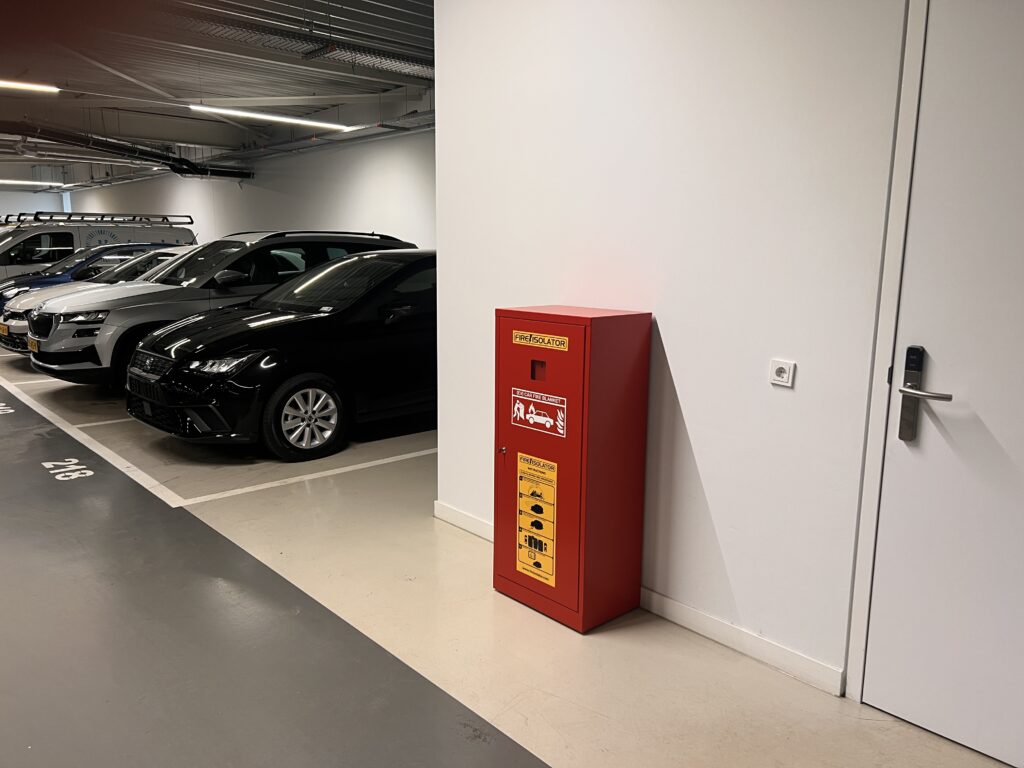
Accessibility matters too. A technically excellent blanket stored in the wrong building or several minutes away from the parking area provides little practical value during an incident.
6. Compare durability and temperature resistance
Temperature resistance is important, but it should not be evaluated in isolation.
Fleet operators should compare the blanket’s material, peak temperature capability, mechanical strength, expected durability and whether the manufacturer provides evidence supporting those claims.
For facilities expecting frequent handling, training or demanding professional use, durability can be particularly important.
FIRE⚡ISOLATOR offers different blanket constructions so customers can select a solution appropriate to their risk profile and operational requirements. Our blankets can withstand temperatures of up to 2000 degrees Celsius (
7. Look beyond certificates
Independent testing and certification are valuable and should form part of the purchasing decision.
For example, FIRE⚡ISOLATOR’s Ultimate EV Fire Blanket has been tested according to ISO EN 13501-1, NFPA 701, ASTM D6413 and DIN SPEC 91489.
But certification should not be confused with proof that a blanket will extinguish every EV battery fire.
Fleet managers should look at both laboratory testing and practical fire experience and ask manufacturers to clearly explain what their certifications actually demonstrate.
So, what is the best EV fire blanket for a vehicle fleet?
There is no single blanket that is automatically “best” for every rental company.
A small location with 30 passenger vehicles has different requirements from an airport rental hub storing hundreds of vehicles, just as an outdoor parking area presents different challenges from an underground facility.
A good EV fire blanket for a vehicle fleet should therefore:
- have documented fire-performance testing;
- be appropriately sized for the fleet’s vehicles;
- provide sufficient temperature resistance;
- be practical for trained personnel to deploy;
- have a clearly explained strategy for gases produced during thermal runaway;
- be supported by realistic deployment procedures and training;
- and be treated as part of a broader EV fire containment strategy rather than a miracle solution.

Why FIRE⚡ISOLATOR takes this approach
FIRE⚡ISOLATOR has conducted more than 15 live tests involving hybrid vehicles, fully electric vehicles and lithium-ion batteries in thermal runaway.
Those tests have shaped our products.
They have also taught us something equally important: EV fires are complex, and there is no single tool that solves every EV fire scenario.
That is why we developed FIRE⚡ISOLATOR as a complete containment concept.
Our Economy, Ultimate and Ultra blankets construction allow gases and vapours to breathe through the material rather than intentionally creating an airtight enclosure. Our wider concept provides additional tools for suppressing flames and managing the incident. And our recommendations continue to evolve based on what we observe during real tests and deployments.
We believe fleet operators should expect this level of transparency from every EV fire blanket supplier.
Don’t only ask how hot a fire blanket can get. Ask how it was tested, what happens to the gases underneath it, what it can and cannot do, and how it fits into your complete EV fire-response plan.
That is a much better way to compare EV fire blankets, and a much safer starting point for protecting a modern rental fleet.