



Containing the Unstoppable: How We Protect Car Carriers from Lithium Battery Thermal Runaway
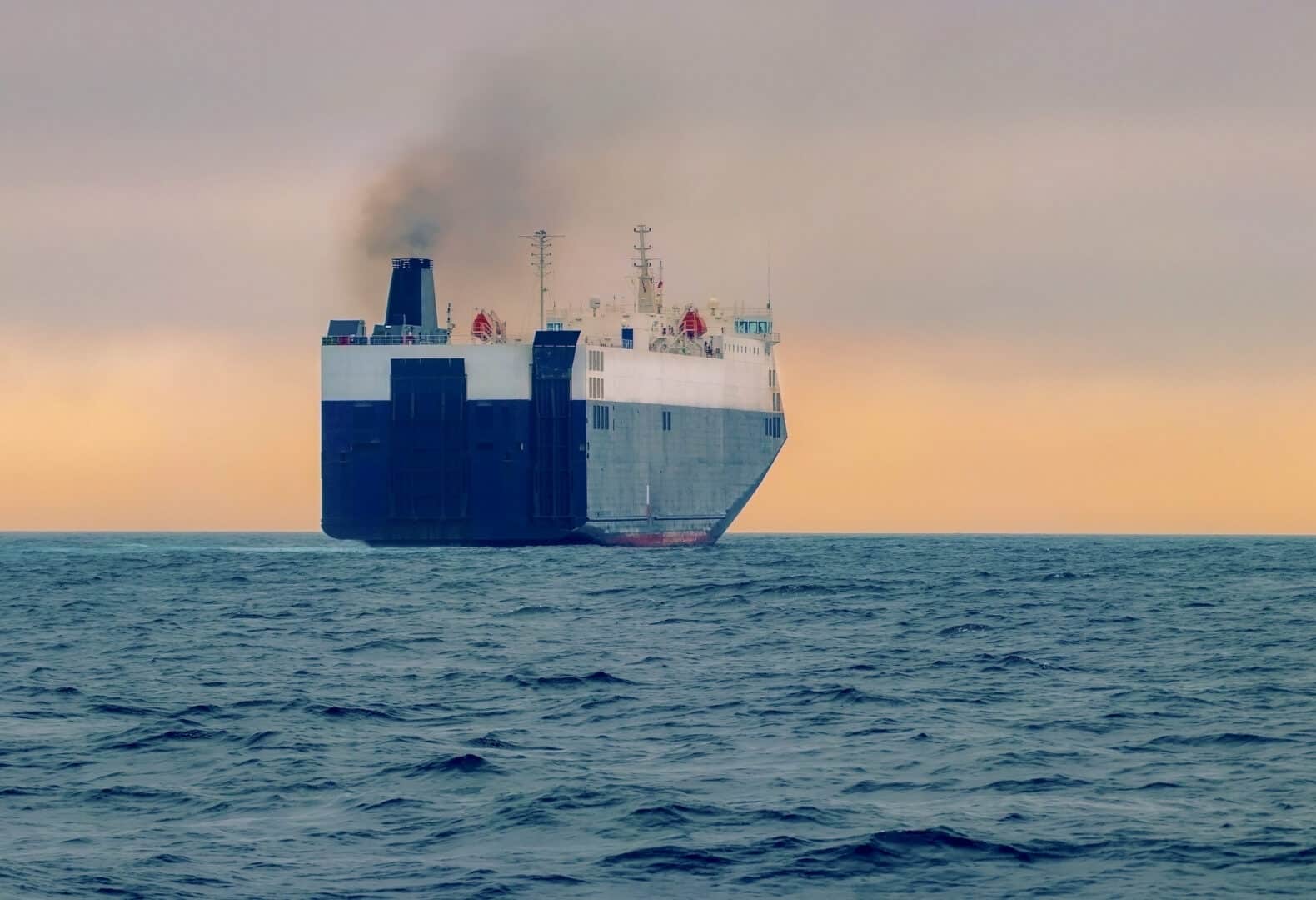
There is no bigger “hot topic” in the maritime insurance world right now than the transport of Electric Vehicles and EV Fire containment on Car Carriers. As the global fleet of car carriers expands to meet the demand for EVs, the industry is waking up to a hard reality: traditional CO₂ or drencher systems are not designed for a lithium-ion battery in thermal runaway. Or at least not to extinguish these fires as a standalone tool. This is not a conventional engine-room fire. It is a chemical chain reaction that generates its own oxygen and can reach temperatures exceeding 1,200 degrees Celsius.
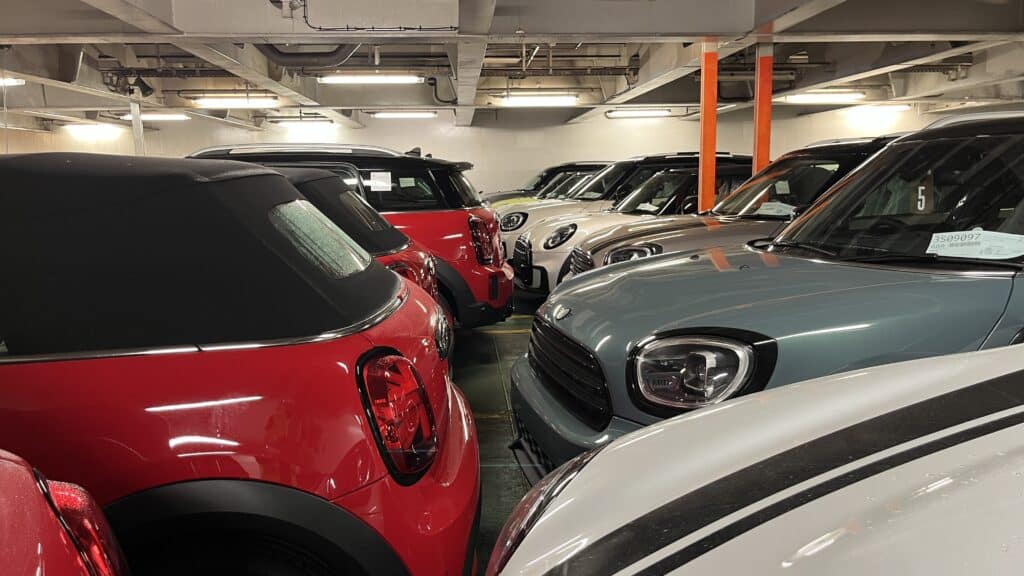
On a RoRo deck, space is tight. Vehicles are parked bumper-to-bumper, often only centimeters apart. If one EV goes into thermal runaway, radiant heat alone can ignite the next car within minutes. Fire hoses struggle to reach the battery pack, which is protected under the vehicle floor. Meanwhile, applying excessive water to cool the battery raises serious stability concerns. Hundreds of tons of water on a vehicle deck is not something any captain wants to explain to a classification society or insurer.
This is the new fire frontier at sea. And it requires a containment mindset rather than a traditional extinguishing mindset.
The Fire Isolator Concept: Containment First, Extinguishment Second
At Fire Isolator, we developed a layered response concept specifically for EV Fire containment on car carriers and RO-RO ferries. The objective is clear and operationally realistic: isolate the vehicle immediately, prevent fire spread, protect the vessel, and buy time for controlled cooling.
High-Temperature Fire Blanket: Immediate Isolation
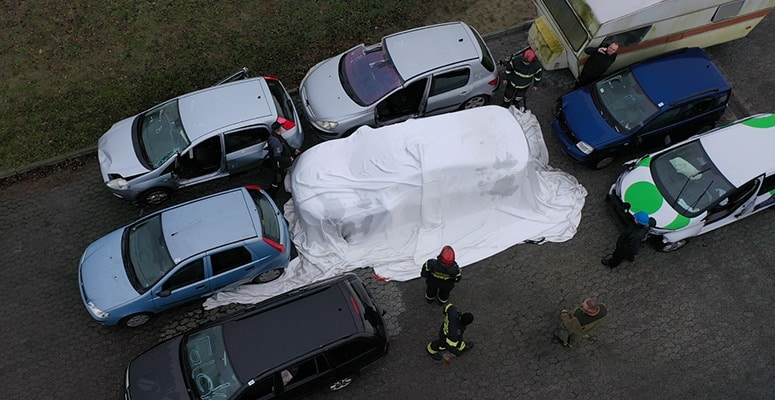
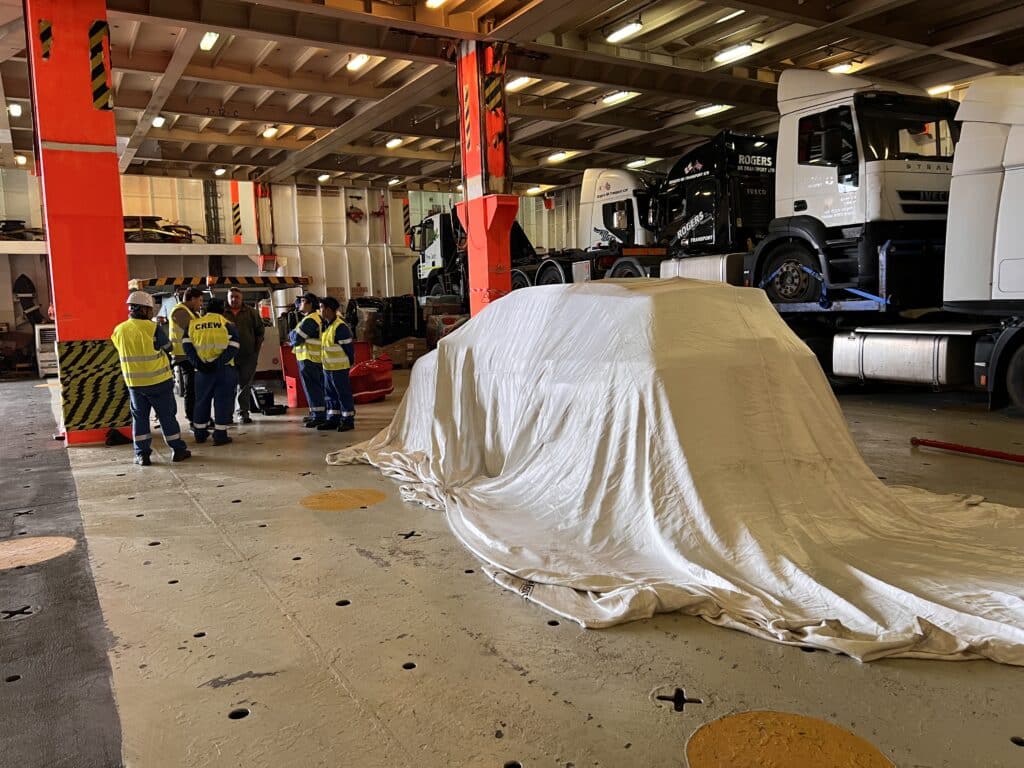
Our High Temperature Fire Isolator blanket is the first tactical step. Once an EV fire is identified, the crew deploys the blanket over the vehicle. On a RoRo deck, speed and simplicity matter. The blanket can be positioned quickly by trained crew, even in reduced visibility.
The blanket:
- Withstands extreme temperatures
- Drastically reduces radiant heat to adjacent vehicles
- Protects deckhead structures and fire detection cabling
- Contains flames and significantly limits smoke spread
For a ship’s master, this means the fire is no longer radiating uncontrolled heat across the deck. Instead of a row of cars igniting one after another, the incident is physically isolated to one footprint.
Importantly, the blanket also contains the highly toxic vapors released during battery failure. On enclosed vehicle decks, smoke management is critical. Containment reduces the risk to crew entering with breathing apparatus and limits contamination across the vessel.
Note that being to able to reach the car is not a given. Sometimes you cannot reach the car on fire, or the fire is already to advanced to approach the car. These are realistic considerations and caused us to be careful when discussing the effectiveness of any firefighting or fire containment tool at sea. You need to be able to reach the car in the first place.
Water Mist: Controlled Cooling Without Flooding the Deck
Once the vehicle is isolated, cooling becomes the priority.
Traditional hoses cannot penetrate the battery casing. Spraying water over the exterior of the vehicle is inefficient and leads to unnecessary water accumulation. That is why our system includes several water mist applicators.
The (underbody) water mist applicators and handheld water mist lance produces a fine mist that:
- Rapidly absorbs heat
- Cools the car with the blanket on it, minimizing toxic vapors from escaping into the ventilation system
- Uses significantly less water than conventional hose streams
For captains concerned about vessel stability, this is a critical advantage. Instead of flooding a deck to fight one car, cooling is targeted and controlled.
Aerosol Units – Chemical Flame Interruption
Lithium battery fires produce secondary flames fueled by released gases. These flames can extend beyond the battery enclosure and ignite surrounding materials.
Our aerosol units are deployed to interrupt these chemical flames. They work under the blanket by:
- Disrupting the combustion chain reaction
- Reducing flame intensity
- Supporting the containment zone created by the blanket
This combination ensures that the fire is not only physically covered but also chemically suppressed at the surface level.
EV Fire Gun – Direct Battery Penetration
In cases where the battery pack remains in sustained thermal runaway, surface cooling alone may not be sufficient. This is where our EV Fire Gun provides a decisive tactical option.
The EV Fire Gun is designed to penetrate the battery casing, allowing water or cooling agent to be delivered directly into the core of the battery pack. From an operational standpoint, this means:
- Faster temperature reduction
- Interrupting propagation between battery cells
- Reducing re-ignition risk
- Shortening overall incident duration
For a ship operator, this translates into reduced damage, reduced downtime, and reduced exposure to total loss scenarios.
A Tactical Toolkit for Modern Car Carriers
For shipowners and masters, the key question is not “Can we instantly extinguish a lithium battery fire?” The realistic question is:
Can we stop it from taking the ship?
If the car can be reached, the Fire Isolator concept transforms an uncontrollable, escalating EV fire into a controlled and isolated incident. Instead of reacting with massive water application and hoping for the best, crews have a structured response:
- Isolate with the blanket
- Cool with controlled water mist
- Suppress secondary flames with aerosol
- Penetrate the battery if necessary
This layered approach aligns with what captains and chief officers understand best: damage control, compartmentalization, and time management.
Embracing the EV Era Without Compromising Safety
The EV revolution is not slowing down. Car carriers will continue to transport increasing numbers of electric vehicles across oceans. Insurance underwriters, classification societies, and flag states are all demanding clearer mitigation strategies.
Fire Isolator provides shipowners with more than equipment. We provide a defensible containment philosophy tailored for RoRo operations.
Because at sea, the priority is simple: protect the crew, protect the vessel, and make sure one burning vehicle does not becomea total loss.