


Fire Isolator Fire Blanket Demonstrates Effective Lithium-Ion Battery Fire Containment in Singapore Civil Defence Force Test
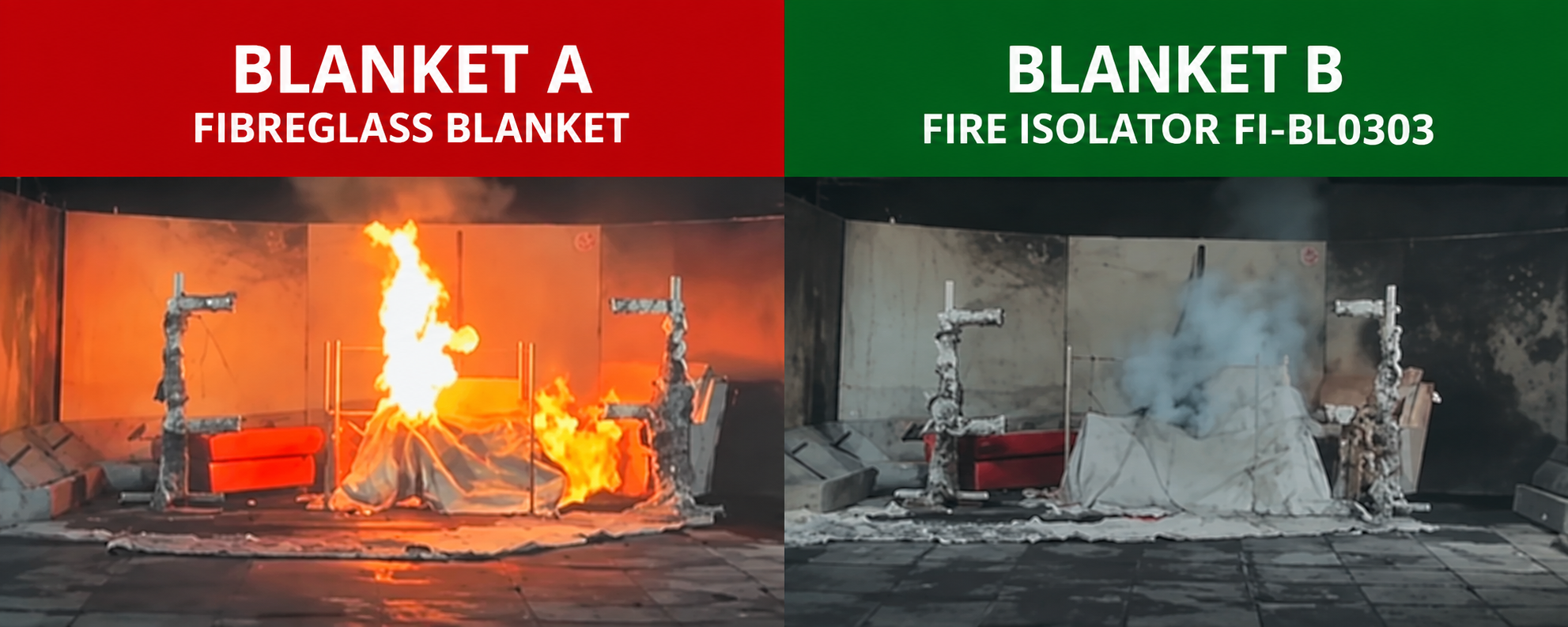
A comparative fire blanket experiment presented by the Singapore Civil Defence Force (SCDF) highlights the importance of blanket material selection when containing lithium-ion battery fires.
During a technical presentation at SIDEX–ACDR 2026, the Singapore Civil Defence Force shared experimental findings on the use of fire blankets to contain fires involving lithium-ion batteries.
The presentation compared two different fire blankets in a small battery fire scenario: Fire Blanket A, identified as a fiberglass blanket, and Fire Blanket B, the Fire Isolator FI-BL0303, manufactured from 97% silica fabric.
The results demonstrated a significant difference in containment performance.
Fire Blanket A: Flames Escaped the Containment Area
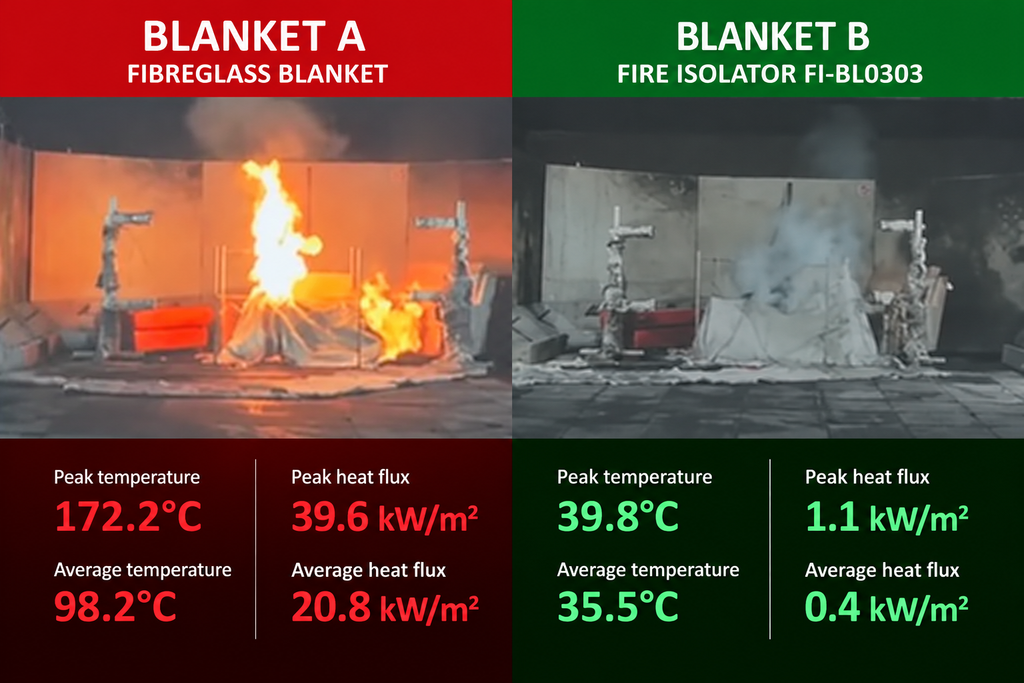
During the experiment with Fire Blanket A, the presentation documented burn-through and flames escaping through openings in the blanket.
The reported measurements included:
- Peak temperature: 172.2°C
- Average temperature: 98.2°C
- Peak heat flux: 39.6 kW/m²
- Average heat flux: 20.8 kW/m²
These observations illustrate how blanket performance can affect the ability to contain a developing lithium-ion battery fire.
Fire Blanket B: Fire Isolator FI-BL0303 Blanket Successfully Contained the Flames
The experiment involving Fire Blanket B, the Fire Isolator FI-BL0303 silica blanket, showed a markedly different outcome.
According to the presentation, the fire remained contained within the blanket, with only minor flame escape observed during the experiment.
The reported measurements were:
- Peak temperature: 39.8°C
- Average temperature: 35.5°C
- Peak heat flux: 1.1 kW/m²
- Average heat flux: 0.4 kW/m²
These substantially lower recorded temperatures and heat flux values support the observed improvement in containment performance under the tested conditions.
Why Blanket Material Matters
Fire blankets are increasingly considered as part of lithium-ion battery fire response strategies. However, not all fire blankets are manufactured from the same materials or designed to withstand the same conditions.
Conventional fiberglass fabrics and high-silica fabrics differ in their material composition and thermal properties.
Fire Isolator’s FI-BL0303 is manufactured from 97% silica fabric and is designed for high-temperature fire containment applications.
The Singapore presentation reinforces an important principle: the choice of blanket material can significantly influence containment performance.
Independent Experimental Findings
The SCDF presentation concluded that pre-deployed fire blankets show potential to help contain battery mobility device fires in residential settings.
It also identified blanket material properties and temperature ratings as important factors affecting effectiveness.
These findings are particularly relevant to fire safety professionals evaluating solutions for lithium-ion batteries in smaller mobility devices and other battery-powered equipment.
The experiment involved smaller lithium-ion battery applications, not a full-size electric vehicle fire. Its findings should therefore be interpreted within the conditions tested.
Fire Isolator: Committed to High-Performance Fire Containment
At Fire Isolator, we have consistently emphasised the importance of using high-temperature silica fabrics for demanding fire containment applications.
We welcome the findings presented by the Singapore Civil Defence Force, which provide valuable experimental evidence supporting the performance of our FI-BL0303 silica blanket in this specific comparison.
Effective fire containment starts with choosing the right materials.
Read more about our FI-BL0303 fire blanket here: https://fireisolator.com/ebike-and-escooter-blankets/
Request a quote: https://fireisolator.com/contact/