



Lithium Battery Storage: Fire Risks, Safety Guidelines, and Effective Fire Suppression Solutions

As the world shifts toward electrification, lithium battery storage has become an essential part of our everyday lives—from electric vehicles and e-bikes to industrial energy systems and warehouses. These high-energy power sources offer efficiency and convenience, but they also come with a serious risk: fire.
When stored or handled improperly, lithium batteries can overheat, ignite, or even explode due to a phenomenon known as thermal runaway. These fires are notoriously difficult to control and pose significant safety hazards for people, property, and the environment.
In this article, we’ll explore why lithium battery storage carries fire risks, how to store these batteries safely, and most importantly, what to do in the event of a lithium battery fire. We’ll also introduce Fire Isolator—a professional-grade solution designed to suppress and contain lithium battery fires quickly and effectively.
Why Lithium Battery Storage Is More Important Than Ever
Like we said before, our world is slowly shifting towards electrification: we are switching from machines and systems that run on fuel to ones that run on electricity. And this is a good thing – because electricity, especially from renewable sources, creates less pollution, lowers operating costs, and helps build a more sustainable future. But what most people forget, is that electrification also comes with a serious risk: the risk of fire.
What Causes Fires in Rechargeable Battery Systems?
Fires in rechargeable battery systems, especially lithium-ion batteries, are usually caused by damage, overheating, or manufacturing defects. These issues can lead to short circuits, which cause the battery to heat up rapidly. If the heat isn’t properly managed, it can trigger thermal runaway, a chain reaction that results in fire or even explosion.
Here are some common causes:
- Overcharging or incorrect charging
- Physical damage
- Exposure to heat
- Poor-quality batteries or defects
- Improper storage
Understanding Thermal Runaway and Its Fire Risk
Electric vehicles like EV cars, but also machinery such as Forklift Trucks or Pallet Trucks, run on electric batteries, mostly on lithium-ion batteries. Thermal runaway is a dangerous chain reaction that can happen inside such a lithium-ion battery when it gets too hot. Thermal Runaway often starts with something small—like a short circuit, physical damage, or overheating during charging. But once the temperature inside the battery rises past a certain point, it starts to heat up fast.
This heat causes the battery’s internal materials to break down, releasing even more heat and flammable gases. That creates a cycle: more heat → more breakdown → more heat. Eventually, this can lead to fire, explosion, or the release of toxic smoke.
The scariest part? Once thermal runaway begins, it’s extremely hard to stop. Even if you think the fire is out, it canreignite minutes or even hours later.
Can Batteries Catch Fire When Not in Use?
Yes, lithium-ion batteries or other rechargeable batteries can catch fire even when they are not being used. While it is less common, they can still pose a risk. This can happen due to internal damage, improper storage or manufacturing flaws. Even a battery sitting on a shelf can go into Thermal Runaway, under the right (or should we say wrong) conditions.
At What Temperature Do Battery Fires Start?
Battery fires typically start when the battery’s internal temperature reaches around 130°C to 150°C (266°F to 302°F). At this point, the internal components begin to break down, and if the heat continues to build, it can trigger Thermal Runaway.
During Thermal Runaway, the battery can quickly reach temperatures of over 600°C (1,100°F), and in extreme cases, even up to 1,000°C (1,800°F) or more. That’s hot enough to ignite nearby materials and cause serious damage.
Are High-Energy Batteries Safe for Indoor Environments?
Yes, but only when properly stored, following clear safety measures. These batteries are powerful and efficient, which makes them ideal for equipment like electric forklifts and other industrial tools commonly used inside warehouses and factories.
However, they also come with fire and overheating risks if not handled correctly. Therefor, to keep indoor use safe, it’s important to follow manufacturer guidelines, store batteries correctly, keep them away from flammable materials and use certified equipment. But even then – we strongly recommend to always be prepared for the unexpected. That means having the right fire suppression tools on hand in case a lithium battery fire does break out — such as a lithium fire blanket, watermist lance, or aerosol unit from Fire Isolator. These solutions are specifically designed to contain, cool, and control high-temperature battery fires quickly and effectively, helping you protect your people, property, and operations.
Lithium Battery Storage Regulations: What You Need to Know by Country or Region
United States: NFPA and UL Standards Lead the Way
In the United States of America, lithium battery storage is primarily regulated through the NFPA (National Fire Protection Association) 855 standard, which outlines how energy storage systems—including those using lithium-ion batteries—should be safely installed and managed. This standard emphasizes fire suppression, spacing, and ventilation. Complementing it are UL 9540 and UL 9540A, which certify and test battery systems for fire safety and thermal runaway risks. In addition, OSHA requires all employers to maintain a safe workplace, which includes proper handling and storage of potentially hazardous batteries.
European Union: A Mix of Directives and Local Regulations
Across the European Union, lithium battery storage is regulated through a combination of EU-wide legislation and country-specific rules. The Battery Directive—which is being replaced by the new Battery Regulation 2023/1542—focuses mainly on environmental safety and how batteries are handled at the end of their life.
When it comes to safe storage, technical standards like EN IEC 62619 (for battery systems) and EN 60079 (for explosive environments, also known as ATEX) are important.
United Kingdom: HSE Guidance and International Standards
In the United Kingdom, the Health and Safety Executive (HSE) provides clear guidance on how to assess and mitigate risks related to lithium battery storage. Businesses are expected to identify fire hazards and prepare appropriate safety measures, including containment and suppression solutions. The UK also increasingly references NFPA 855 and UL 9540A as best practice frameworks, especially in larger installations. When battery systems are integrated into buildings, BS 7671 (IET Wiring Regulations) may also apply.
Asia: Rapid Growth, Tightening Safety Standards
Countries in Asia are quickly adapting to the rising use of lithium-ion batteries with evolving safety standards. In China, the GB/T standards regulate how batteries should be tested and stored, especially in industrial and logistics facilities. Fire departments also enforce local codes depending on the battery size and setting. Japan applies rules from its Ministry of Economy, Trade and Industry (METI), often aligned with international IEC norms but tailored for earthquake and disaster-prone regions. Meanwhile, South Korea has tightened fire safety inspections and thermal runaway prevention requirements, following several high-profile battery fire incidents.
How to Reduce the Risk of Battery-Related Fires
In our professional opinion, you should always be prepared for a possible lithium battery fire. But taking precautions is always better than dealing with the damage afterward. To avoid battery hazards, handle and store batteries with care. Always use the correct charger, avoid overcharging, and never use damaged or swollen batteries. Store them in a cool, dry, and well-ventilated area—away from flammable materials—and follow the manufacturer’s safety instructions. Regular inspections and proper staff training can help prevent accidents before they happen.
What to Do During a Lithium Battery Fire Emergency
If a lithium battery fire breaks out in your warehouse or storage facility, act quickly but safely. These fires burn at extremely high temperatures and can reignite unexpectedly, so using the right tools and approach is crucial.
- Evacuate the area immediately to protect personnel. Lithium battery fires can release toxic smoke and intense heat.
- Do not use water—it’s ineffective and potentially dangerous when dealing with lithium-based fires.
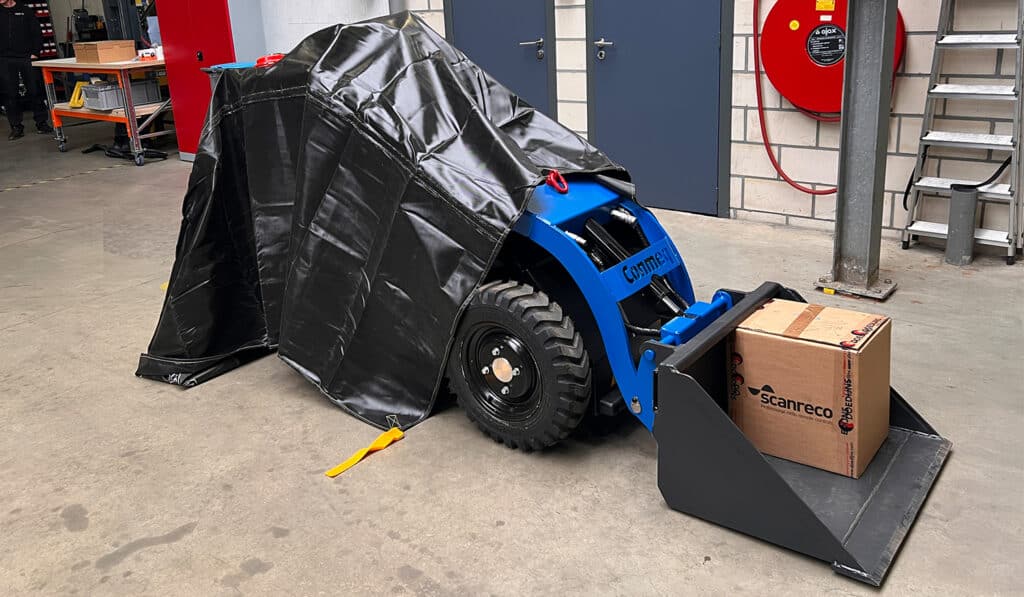
- We strongly recommend to deploy a certified Lithium Fire Blanket as soon as it’s safe to do so. Fire Isolator’s Lithium Fire Blanket is designed to contain and control fires caused by lithium batteries. It can withstand temperatures up to 1600°C (2900°F) and hold out for more than 50 hours at 1200°C (2200°F).
- Cover the burning battery completely, using the blanket’s color-coded loops for quick and intuitive deployment. This helps cut off the oxygen supply, slowing the fire and reducing the risk of it spreading.
- Wait for professional firefighters to arrive if the fire cannot be fully contained. Even if the fire appears to be extinguished, there’s still a risk of reignition due to thermal runaway.
Having a Lithium Fire Blanket on-site, along with training and safety protocols, ensures you’re prepared for the worst-case scenario—protecting your people, your property, and your operations.
Is Water Effective Against Battery Fires?
No, ‘just’ water is not effective to control or put out a fire caused by a lithium battery. However, when used in the form of a watermist, in combination with a Fire Blanket, it becomes a powerful tool in fighting these intense fires.
Fire Isolator’s Watermist Applicators provide an innovative and effective solution for suppressing fires, particularly in high-risk situations like EV battery fires. Using advanced water mist technology, these systems rapidly cool the fire, reduce heat, and minimize toxic vapors.
Designed for versatility, they enhance overall safety while limiting damage to surrounding goods and equipment — making them an essential tool for modern firefighting.
How Long Can a Battery Fire Burn?
In many of our live test we have experienced that Battery fires can burn for hours, especially with larger batteries like those in electric forklifts or EVs. And even when it looks like the fire is out, it can reignite unexpectedly due to Thermal Runaway.
That is what makes these fires so tricky; you are not just putting out flames, you’re dealing with stored energy that keeps reacting. This is why we always recommend having the right tools on hand, like a lithium fire blanket and a watermist applicator, to contain the fire fast and keep it from coming back.
The Most Effective Way to Suppress Lithium Battery Fires with the Fire Isolator concept
Lithium battery fires are intense, long-burning, and difficult to extinguish. That’s why containment is one of the most effective ways to manage them safely.
For these kind of situations, we recommend our Lithium Fire Blanket, tested to 1600°C and according to ISO EN 13501-1, NFPA701 & ASTMD6413. While a fire blanket alone will not extinguish the battery fire itself, it will isolates the battery, controlling the situation, and preventing flames from spreading—buying valuable time.
To support this, the concept includes:
- Aerosol units to chemically suppress flames and reduce heat
- Watermist applicators to cool and reduce toxic smoke
- Thermal imaging for hotspot detection
- On-site training for proper deployment
- An EV Firegun to penetrate the battery and fully cool battery cells to prevent reignition
This combination provides a safe, structured response to lithium battery fires in EVs and energy systems.
If you have any questions, please get in touch with us any time!