



The EV Fire Blanket is Just the Start: Introducing the Fire Isolator System
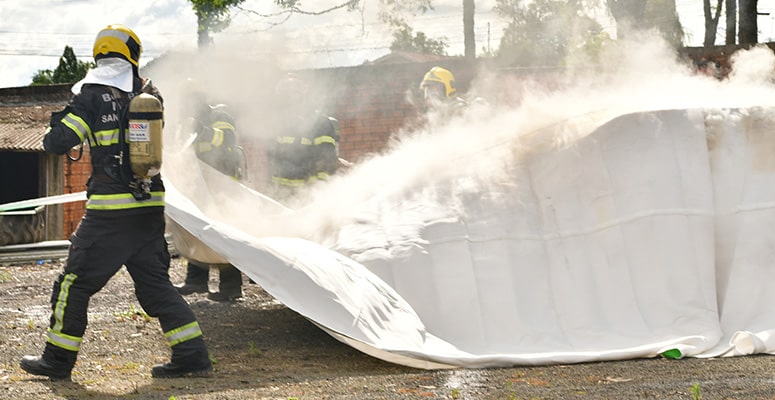
For emergency responders, the EV fire blanket is now a key first-response tool. It provides a practical way to address the unique risks of lithium-ion battery fires, particularly thermal runaway. Containment appears logical: cover the vehicle, minimize collateral damages, let the constant reignition take place under the blanket instead of pointlessly pouring thousands of liters of water on it.
However, experienced responders know that covering a burning EV is only the first step. The main challenge is not just containing visible flames, but also managing heat buildup and preventing re-ignition. A standalone blanket, while useful, does not address all critical risks.
That’s why at Fire Isolator, we pioneered something fundamentally different. Not just a better blanket, but a complete operational system. We invented Fire Isolator, a coordinated response protocol that integrates containment, suppression, monitoring, and cooling into a single, scalable tactic. This isn’t an add-on. It’s the next generation of EV fire safety.
The Fire Isolator Concept: An Integrated System, Not a Single Product
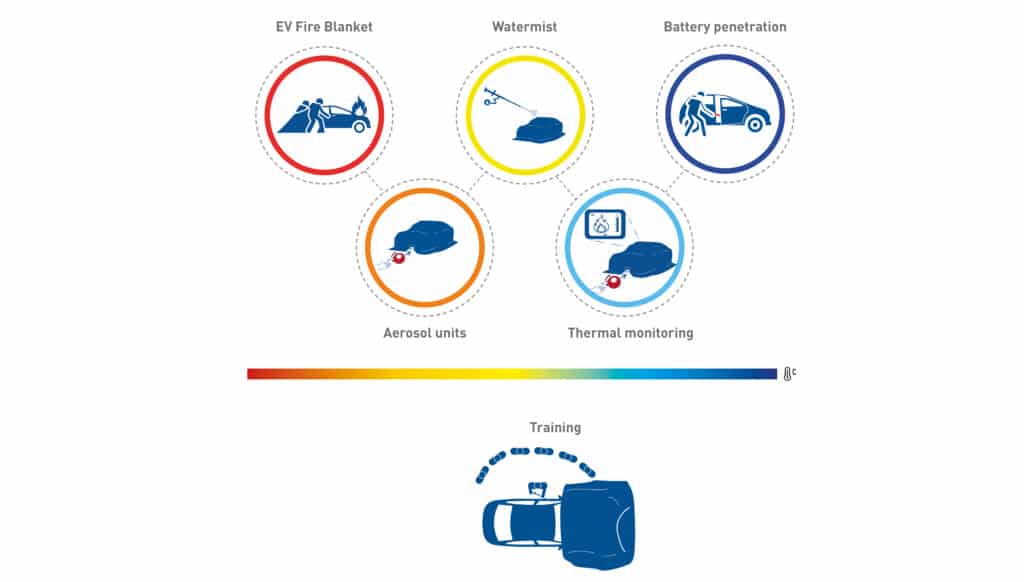
We didn’t set out to make a better EV fire blanket. We set out to solve the entire problem. Fire Isolator is a four-pillar system engineered to work in sequence, turning a reactive cover tactic into a proactive fire management protocol.
1. Smart Containment – The High-Performance Blanket
Our engineered Fire Blanket is the system’s first layer, but it’s not a standalone product. It’s a foundation designed specifically to work in concert with other components. Made from a high % silica weave (with or without a graphite coating for extra durability), it creates a sealed environment that allows the rest of the system to do its job safely and effectively.
2. Targeted Suppression – Potassium Nitrate Aerosol Units
This is where the Fire Isolator fundamentally diverges from conventional approaches. Once containment is established, specially formulated Potassium Nitrate Aerosol Units are deployed under the EV fire blanket. These units attack the fire at its chemical root, interrupting the chain reaction of thermal runaway inside the contained space. This is sub-blanket suppression, a game-changer in actually stopping the fire, not just hiding it.
Once the blanket is on the car, the battery will keep in thermal runaway. So we need a ‘firefighter’ under the blanket that is able to reach the battery that is built in deep inside the car. That ‘firefighter’ is our aerosol units.
3. Real-Time Intelligence – Thermal Monitoring
You can’t manage what you can’t measure. Handheld thermal sensors provide continuous temperature data from beneath the blanket. This allows responders to:
- Monitor the effectiveness of suppression
- Identify hot spots before they escalate
- Make data-driven decisions on when and where to cool or re-apply aerosol units and/or water mist cooling
- Verify when the incident is truly stable
4. Active Cooling – Directed Water Mist Systems
The final pillar addresses the most persistent threat: residual heat. Strategic Watermist devices target the vehicle’s underbody and battery compartment from the sides, providing sustained cooling without flooding or unnecessary water damage. This step is critical to preventing re-ignition and safely concluding the incident.
The Operational Shift: From a Tool to a Tactic
Adopting and deploying Fire Isolator isn’t just about buying new equipment, it’s about upgrading your entire response methodology. We provide not just the components, but the training and deployment protocol that turns individual pieces into a repeatable, effective tactic:
- Contain with the blanket to establish a controlled zone.
- Suppress with aerosol units deployed underneath to attack the source.
- Monitor with live thermal data to guide decisions.
- Cool with targeted mist to neutralize residual risk.
- Secure the scene with verified stability.
This systematic approach reduces guesswork, shortens incident duration, and significantly lowers the impact of the constant re-ignition in the battery. It transforms the EV fire response from a hopeful containment exercise (‘just use water…said nobody who dealt with EV fires ever) into a confident, controlled mitigation process.
The Future of EV Fire Safety is Integrated
The industry is moving beyond the blanket, because the problem demands it. As battery densities increase and EV adoption grows, fires become more energetic and complex. The solution must evolve in parallel.
Fire Isolator represents that evolution: a coordinated system built from the ground up to address the full lifecycle of an EV battery fire. It starts with the blanket everyone recognizes, but it doesn’t end there.
We invite you to learn more about how the integrated system works.
Go watch our live test videos to see the technical specifications, deployment protocols, and case data that define the next standard in EV fire response. For specifications on our EV fire blankets and the other components of the Fire Isolator concept, please visit our Products Page.